
A+P were instructed to produce a Masterplan Vision Document to set out a proposal for the creation of a sustainable, mixed residential community on previously developed land at the edge of an existing urban area. The project explored how a disused parcel of land could be transformed into a carbon-neutral neighbourhood, one that celebrated landscape, supported biodiversity, and provided much-needed homes within walking distance of key local amenities.
The study established a framework for delivering a multi-generational community shaped by the principles of garden neighbourhood design. The vision was to create a beautiful, inclusive, and enduring place, one that combined green infrastructure with high-quality architecture to promote wellbeing, connectivity, and sustainable living.
Key objectives included:
Integrating new development seamlessly into the existing urban fabric.
Creating a strong sense of place defined by landscape and characterful architecture.
Promoting low-carbon design through fabric-first principles and renewable energy.
Encouraging active lifestyles through walkable streets and accessible open spaces.
Preserving existing trees and ancient woodland as defining landscape features.
The masterplan was designed to achieve a balanced relationship between built form and green space, ensuring that the new neighbourhood sat lightly within its surroundings while contributing positively to the wider community.

EXISTING SITE PLAN
A detailed site assessment informed the design process, identifying opportunities to retain mature landscape features, enhance biodiversity corridors, and connect to surrounding walking and cycling routes. The topography of the site and its natural features, including existing woodland and watercourses, were used to shape the structure of the masterplan.
Three distinct character zones were developed:
Higher-density zones, located near existing employment and infrastructure, accommodating apartment buildings and terraced homes.
Medium-density zones, featuring two and three-storey townhouses arranged around shared green streets.
Lower-density areas, providing detached and semi-detached family homes set within generous gardens and soft landscape edges.
Each area was carefully scaled to reflect neighbouring development and to provide a natural transition from the urban edge to a more open, rural setting.
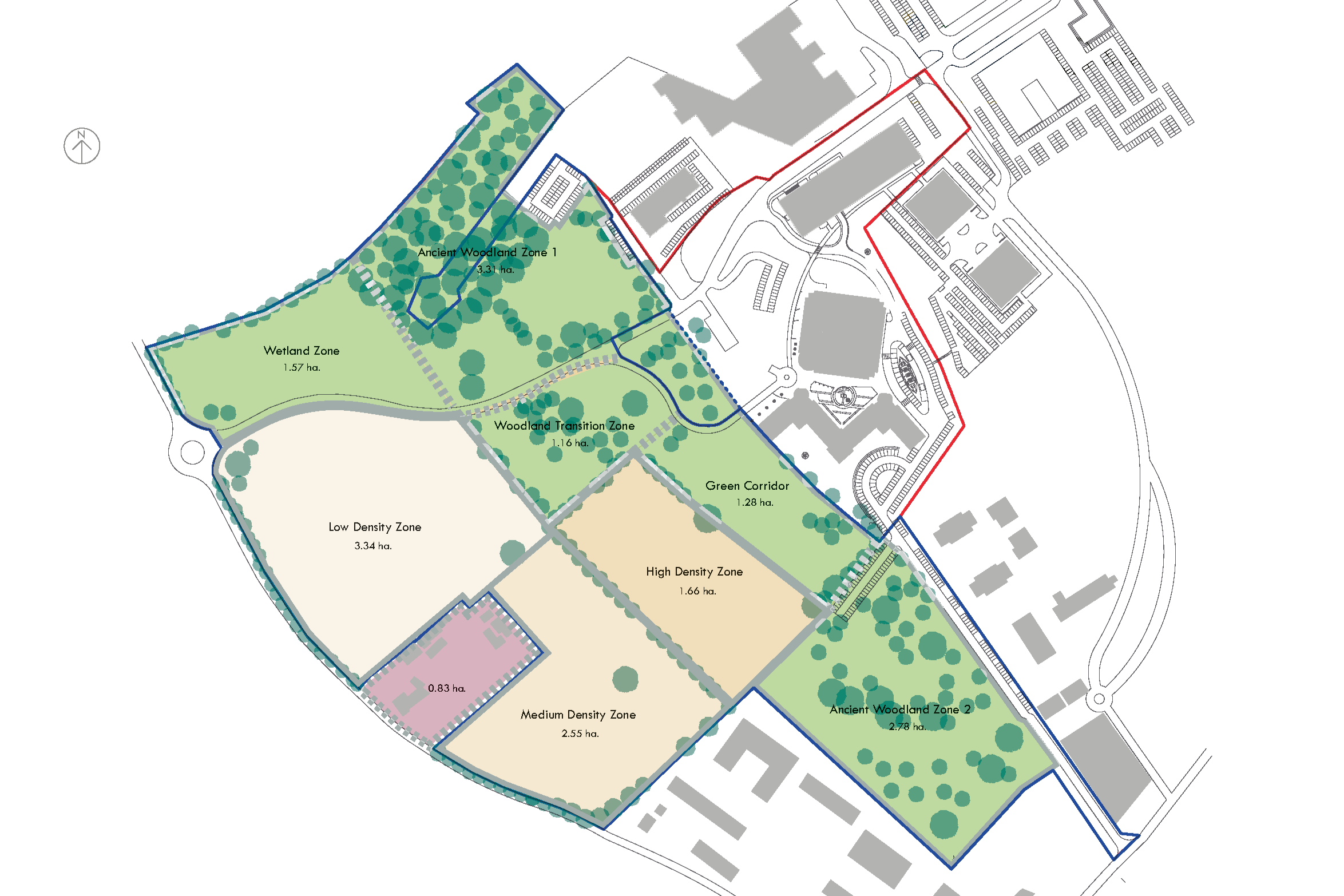
PROPOSED MASTERPLAN ZONAL DIAGRAM
The masterplan framework illustrated how the site could accommodate around 350 new homes, supported by community uses, open spaces, and new connections to surrounding neighbourhoods.
Key elements included:
A central linear park forming the green spine of the development.
Retention and enhancement of ancient woodland and wetland habitats.
A network of pedestrian-focused streets and green corridors.
A series of public squares and play spaces positioned around mature trees.
A woodland walk linking key natural features and connecting to adjacent open land.
The integration of community facilities and opportunities for social interaction within a compact, walkable layout.
The framework aimed to demonstrate how the development could deliver a balanced, nature-led residential neighbourhood that aligned with national and local sustainability goals.

PROPOSED MASTERPLAN FRAMEWORK DIAGRAM
The proposals were guided by six key design principles:
Landscape-led placemaking; Green infrastructure structured the layout, providing character, shade, and ecological value.
Diverse housing typologies; A mix of homes supported family living, downsizing, and affordable tenure.
Active and walkable streets; Prioritising pedestrians and cyclists over vehicles.
Integration with existing communities; Respecting the rhythm and scale of adjacent development.
Sustainable construction; Emphasising low-carbon materials and renewable technologies.
Community and wellbeing; Providing accessible open spaces, play areas, and opportunities for social connection.

PROPOSED MASTERPLAN VISION
The Masterplan Vision demonstrated how thoughtful urban design could transform an underused site into a vibrant, sustainable neighbourhood. By balancing density with landscape, protecting existing woodland, and creating walkable, human-scaled streets, the proposal offered a forward-thinking model for future housing, one that met local needs while enhancing environmental and social value.
Type
New Development
A+P Sector
Urban Living
Location
Confidential
Status
Feasibility